Vårt fokus ligger i å bevare vår natur, vår kultur og vårt miljø, å styrke våre sosiale verdier og vår økonomiske levedyktighet.




Vårt fokus ligger i å bevare vår natur, vår kultur og vårt miljø, å styrke våre sosiale verdier og vår økonomiske levedyktighet.

Experience the Northern Lights between fjord and mountains
The Narvik region is located 68 degrees north, under the Northern Lights oval where the Northern Lights are often active. From September to April, dark evenings and nights provide the opportunity to experience the Aurora Borealis over fjords, mountains, valleys and winter landscapes.
What makes the Narvik region particularly interesting for Northern Lights travelers is the variation in the landscape. The weather can be different by the fjord, in the valleys, in the mountains and further inland. If the sky is cloudy in one place, clearer conditions can be found in another. This combination of Northern Lights activity, different microclimates and the ability to move between several landscapes provides good conditions for searching for the Northern Lights.
You can wait for the Northern Lights on your own, join local guides on a Northern Lights hunt or make the journey itself part of the experience, for example on board the Northern Lights train.
Northern Lights season: September–April
Location: 68° north, under the Northern Lights Oval
Best conditions: Dark and clear skies, preferably away from strong light sources
Where: By the fjord, in the valleys, in the mountains and inland
Guide or your own: Both are possible
Can the Northern Lights be guaranteed: No. The Northern Lights and weather are natural phenomena that cannot be controlled
Lorem ipsum dolor sit amet,
consectetur adipiscing elit
Yes. The Narvik region is located under the Northern Lights Oval, the area around the magnetic poles where the Northern Lights activity occurs most frequently. The location at 68 degrees north means that the region has a long Northern Lights season throughout the autumn, winter and the first part of spring.
But the Northern Lights are about more than activity on the sun. To see it, you also need darkness and sufficiently clear skies. Cloud cover can therefore be at least as crucial as the Northern Lights forecast.
This is where the varied geography around Narvik becomes crucial.
The Narvik region runs from the coast and fjords to steep mountains, open valleys and high mountains towards the Swedish border. The large differences in the landscape also create local variations in the weather.
One evening, the clouds may lie over the fjord, while the sky opens further into a valley or on the other side of the mountains. Other evenings, conditions may be best closer to the coast. The ability to move between different areas within short driving distances makes it easier to adapt the Northern Lights hunt to the evening's weather.
For local Northern Lights guides, a large part of the job is therefore about reading both weather forecasts, cloud cover, Northern Lights activity and choosing the place that provides the best opportunities for the evening in question.
A guided Northern Lights chase is especially suitable for those who want to avoid interpreting weather maps, finding dark places and planning the drive themselves.
Local guides follow the conditions and adapt the evening to the weather. Along the way, you will also gain more knowledge about the Northern Lights, the landscape and how to photograph the phenomenon when it appears.
The Northern Lights season in the Narvik region normally lasts from September to April, when the evenings and nights are dark enough for the Northern Lights to be visible. December and January have the most dark hours, but good Northern Lights experiences can also occur both in autumn and towards the end of winter.
There is therefore no single month that is always "best". How good the conditions are on each evening depends, among other things, on Northern Lights activity, cloud cover and local weather conditions.
A longer stay naturally provides more evenings to try your luck. Feel free to combine the Northern Lights hunt with skiing, dog sledding, trains, culture, food or other winter experiences during the day.
The best place can change from night to night.
Look for an area with clear skies, little artificial light and a good view of the sky. Fjord areas, open valleys and places higher up in the terrain can all provide good conditions when the weather plays along. In the Narvik region, the variation between these landscapes is an advantage.
In other words, you do not necessarily need a specific "Northern Lights point". The most important thing is to follow the conditions.
A completely unique way to get away from the city lights is to follow the Ofotbanen railway into the mountains.
The Northern Lights train runs from Narvik station along the historic railway to Katterat. The station is located without a road connection, surrounded by mountains and darkness. Here, guests get off the train and can wait for the Northern Lights by the bonfire and lavvu, while the hosts serve hot drinks and tell them about the railway and the area.
The train journey makes transport part of the Northern Lights experience: from the city by the fjord to the silence inside the mountains.
Both can work. The best fit depends on how you travel and how well you know the winter conditions in the region.
On your own, you have the freedom to wait, move from place to place and plan the evening yourself. Check the weather forecast, cloud cover and Northern Lights forecast before you go, and choose a safe spot where you can park and move around without obstructing traffic.
A guided Northern Lights hunt makes planning easier. The guides know the areas, follow the weather and Northern Lights activity and can change plans according to the conditions. Many tours also include help with Northern Lights photography.
The winter weather in the north can change quickly. Dress according to the conditions and choose a guided tour if you are unsure about the weather, winter driving or where to go.
The Northern Lights do not have to be just an activity in themselves. In the Narvik region, the hunt for the green sky can be combined with several different winter experiences.
Dog sledding takes you out into the winter landscape with a team of eager huskies in front of the sled. Some offers combine dog sledding with evening experiences and northern lights, including in Gratangen.
On snowshoes, you can move calmly out into the snow-covered landscape and away from the buildings. You don't need a ski slope or groomed trails, just the right conditions, warm clothes and an area that is safe to travel in.
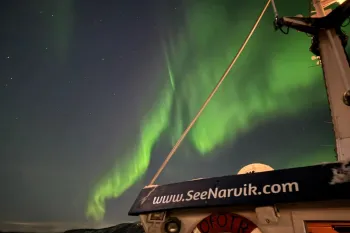
See the Narvik region from the sea as darkness descends over the fjords and mountains. On board the boat Ofotr, you get to experience the silence and darkness between the mountains. When the conditions are right, the Northern Lights can appear over the mountain peaks and be reflected in the fjord, a completely different setting for the Northern Lights experience than on land.
The Northern Lights - Aurora Borealis, occur when electrically charged particles from the sun meet the Earth's magnetic field and are directed towards the polar regions.
When the particles collide with oxygen and nitrogen high up in the atmosphere, energy is released as light. The result can be anything from faint green arcs to powerful moving bands dancing across the sky.
Green is the most common color, but the Northern Lights can also show red, pink, violet and blue tones. The colors we see are related, among other things, to the gases the particles encounter and the height at which the reaction occurs.
You don't have to be a professional photographer to come home with good Northern Lights photos, but the darkness requires a little more from the camera than photography during the day.
With a system camera, a good starting point is to use a wide aperture, relatively high ISO and a shutter speed of a few seconds. Use manual focus and place the camera firmly on a tripod. How long a shutter speed you need depends on both how strong the Northern Lights are and how fast they move.
Newer mobile phones can also photograph the Northern Lights well when the conditions are right. Keep your phone as steady as possible, use night mode if your mobile has one, and avoid digital zoom.
The most important thing is to remember to look up from the screen as well. The Northern Lights can change shape in a matter of seconds.
The Northern Lights chase often involves standing still outside for a long time, and it can feel significantly colder than during an activity where the body is moving.
Dress in layers, with wool closest to the body and warm mid-layers under windproof or weather-protective outerwear. A hat, mittens and warm winter shoes are important. It can also be a good idea to bring an extra insulating layer if you are going to be outside for a long time.
Check the weather forecast before you go, and dress according to the actual conditions, not just the temperature.
No. No one can guarantee that the Northern Lights will appear on a particular evening.
To see the Aurora Borealis, several conditions must work at the same time. It must be sufficiently dark, the Northern Lights activity must be present and you need openings in the cloud cover.
That's why a good Northern Lights experience is also about patience. Some evenings the Northern Lights come early. Other times you wait a long time for the clouds to open. And some evenings it doesn't come at all.
It is part of the encounter with a natural phenomenon that does not follow a schedule.
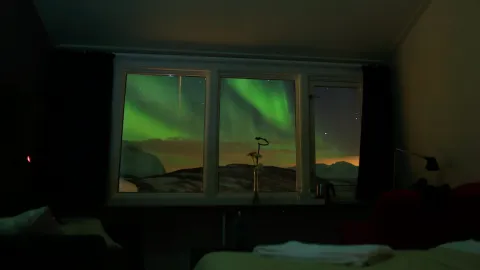
If you want to spend several evenings looking for the Northern Lights, it can be an advantage to choose accommodation with dark surroundings and a good view of the sky.
In the Narvik region, you will find suitable accommodation both in the city, by the fjord, inland and close to the mountain areas. By choosing accommodation outside the strongest light sources, you can follow the night sky directly from where they live.
Choose your base according to what the rest of the journey looks like. From Narvik, the Northern Lights can be combined with city life, train excursions and skiing, while accommodation further out in the region can provide quieter surroundings close to fjords or mountains.
See accommodation options in Narvik Region
The Northern Lights are one part of winter in the Narvik region. Use the days to experience mountains, fjords, train excursions, history, local food, winter activities and let the evenings be open to what is happening in the sky.
The more flexible you can be with time and place, the better equipped you are to follow both the weather and the Northern Lights.
Explore all Northern Lights experiences Experience winter in the Narvik region Find accommodation How to travel to Narvik
The Northern Lights season in the Narvik region normally lasts from September to April. December and January have the most dark hours, but the Northern Lights can also provide powerful experiences throughout the autumn and towards the end of winter.
Narvik is located 68 degrees north under the Northern Lights oval. In addition, the variation between fjords, mountains, valleys and inland gives local weather differences that make it possible to search for clearer skies in different places in the region.
There is no one month that guarantees better Northern Lights than all others. December and January bring many dark hours, while the Northern Lights season as a whole lasts from September to April. Weather, cloud cover and Northern Lights activity on the night in question are crucial.
A dark sky makes the Northern Lights easier to see. Therefore, the Northern Lights experiences mainly take place from autumn to spring, when the Narvik region again has dark evenings and nights.
No. The Northern Lights are a natural phenomenon, and both Northern Lights activity and weather vary. No serious player can guarantee that the Northern Lights will appear on a particular evening.
A guide can make it easier to find good conditions. Local guides follow the weather, cloud cover and Northern Lights activity and can adapt the route to the conditions.
Look for clear skies, as little artificial light as possible, and a place with a good view. Conditions can be different by the fjord, in the valleys, in the mountains, and inland, so the best spot may vary from night to night.
Yes, many newer phones can photograph the Northern Lights. Use night mode if your phone has one, keep it steady and avoid digital zoom.
Dress warmly in layers. Wool, hat, mittens, insulating outerwear and warm shoes are especially important because Northern Lights hunting often involves standing still outdoors for a long time.